 +91-9624695903
  info@primestreamenergy.com
WELCOME TO PRIMESTREAM ENERGY PROJECTS PVT. LTD.
Follow Us
Follow Us



Reducing power factor requires producing reactive energy as close as possible to connected loads. Installing capacitors on the network, such as PSEP Low voltage capacitor banks, Medium voltage capacitor banks,low voltage static var generator, medium voltage STATCOM are the easiest and most common way to achieve this goal.
Active filters are the recommended solution for harmonic mitigation, thanks to their flexibility and high correction performance. Alternative approaches could involve passive filters, multi-pulse arrangement transformers or harmonic correction at the equipment level (for example, by integrating harmonic filtering into variable speed drives).PSEP Active Power Filter can solve this probelm perfectly
Transient voltage surge suppressors are the best option for protecting against transients in a power system.
A large interest has been focused on power quality domain due to: disturbances caused by the non-linear loads, Increase in the number of electronic devices and growth of renewable energy sources. Power quality measures the efficiency of electric power transmitted from generation to the industrial, domestic and commercial consumers. At least 50% of power quality problems are of voltage quality type.
Static Var Generator (SVG) 1. New approach to power factor correction and load balancing 2. Fast response time < 5 ms, with dynamic reaction time less than 10 µs 3. Precise compensation after compensating the target power factor can reach a value of unity 4. Capable of both inductive and capacitive compensation and will avoid under and over compensation issues 5. Minimal loss, better energy efficiency, long-term safe and reliable operation 6. Modular design, compact structure, small footprint, simple operation, easy maintenance
The unit for rating power factor capacitors is a kVAR, equal to 1000 volt-amperes of reactive power. The kVAR rating signifies how much reactive power the capacitor will provide. Sizing capacitors for individual motor loads To size capacitors for individual motor loads, use Table 3 on the following page. Simply look up the type of motor frame, RPM, and horsepower. The charts indicate the kVAR rating you need to bring power factor to 95%. The charts also indicate how much current is reduced when capacitors are installed. Sizing capacitors for entire plant loads If you know the total kW consumption of your plant, its present power factor, and the power factor you’re aiming for, you can contact with us.
When deciding which type of capacitor installation best meets your needs, you’ll have to weigh the advantages and disadvantages of each and consider several plant variables, including load type, load size, load constancy, load capacity, motor starting methods, and manner of utility billing. Load type If your plant has many large motors, 50 hp and above, it is usually economical to install one capacitor per motor and switch the capacitor and motor together. If your plant consists of many small motors, 1/2 to 25 hp, you can group the motors and install one capacitor at a central point in the distribution system. Often, the best solution for plants with large and small motors is to use both types of capacitor installations. Load size Facilities with large loads benefit from a combination of individual load, group load, and banks of fixed and automatically-switched capacitor units. A small facility, on the other hand, may require only one capacitor at the control board. Sometimes, only an isolated trouble spot requires power factor correction. This may be the case if your plant has welding machines, induction heaters, or DC drives. If a particular feeder serving a low power factor load is corrected, it may raise overall plant power factor enough that additional capacitors are unnecessary. Load constancy If your facility operates around the clock and has a constant load demand, fixed capacitors offer the greatest economy. If load is determined by eight-hour shifts five days a week, you’ll want more switched units to decrease capacitance during times of reduced load. Load capacity If your feeders or transformers are overloaded, or if you wish to add additional load to already loaded lines, correction must be applied at the load. If your facility has surplus amperage, you can install capacitor banks at main feeders. If load varies a great deal, automatic switching is probably the answer. Utility billing The severity of the local electric utility tariff for power factor will affect your payback and ROI. In many areas, an optimally designed power factor correction system will pay for itself in less than two years.
You can improve power factor by adding power factor correction(PFC) capacitors to your plant distribution system. When apparent power (kVA) is greater than working power (kW), the utility must supply the excess reactive current plus the working current. Power capacitors act as reactive current generators. Solutions of power factor correction:SVC,TSC,SVG,STATCOM
Low power factor means you’re not fully utilizing the electrical power you’re paying for. Take an exapmle from the triangle relationships 5 demonstrate, kVA decreases as power factor increases. At 70% power factor, it requires 142 kVA to produce 100 kW. At 95% power factor, it requires only 105 kVA to produce 100 kW. Another way to look at it is that at 70% power factor, it takes 35% more current to do the same work.PSEP Solutions: Low voltage capacitor banks;Medium voltage capacitor banks;low voltage static var generator;medium voltage Static Synchronous Compensator) is a voltage regulating device. It is based on a power electronics voltage-source converter and can act as either a source or sink of reactive AC power. It is a member of the Flexible AC transmission system (FACTS) family which detects and instantly compensates for voltage fluctuations or flicker, as well as controls power factor. As a fully controllable power electronic device, the is capable of providing both capacitive and inductive VARs.
1.Natural Events(Hurricanes,Tornadoes,Magnetic Disturbances,Earthquakes) 2.Man-made events(Torrorism,eelectromagnetic,Copper Theft) 3. Changing location& mix of generation
Those harmonics produced by static converters during theo- retically ideal operation. The characteristic harmonic order of static AC/DC converters is given by h = mp ± 1, where p is the pulse number of the converter and m is any integer. For example, the six-pulse converter circuit has characteristic harmonics with order numbers h = 5, 7, 11, 13,1 7, 19… . (IEC 61642)
Harmonics with odd harmonic order,such as 3rd,5th,7th,9th,…,49th order harmonics, Harmonics with even harmonic order.such as 2nd,4th,6th,8th,…,50th order harmonics.
The ratio of the frequency of a harmonic (fh) to the fundamen- tal (rated) network frequency (f1). (IEV 161-02-19 modified)
The component of the Fourier-series decomposition of a volt- age or current periodic wave. (IEV 161-02-18 modified)
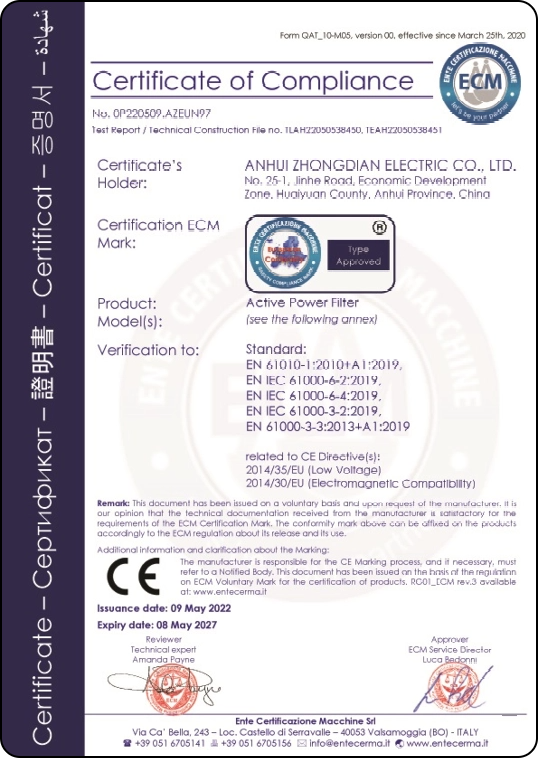
PSEP is a manufacture of power quality solutions, our main products are active harmonic fitler,static var generator and automatic power factor correction panels.
Harmonics The presence of harmonics in the waveform of the network voltage can be attributed to various causes such as rectifiers, variable speed drives, thyristors, saturated transformer, arc furnaces, etc. The main problems caused by harmonics are: • Interferences in telecommunications systems and equipment. • Distortion of the Electricity Supply Voltage • Erratic operation of control and protection relays • Failures in transformers and motors due to overheating caused by core losses. If the harmonic power is significant, i.e. THVD greater than 7 %, THID greater than 40 %, this may result in overvoltages and overloads, which may lead to the failure of the capacitors, circuit breakers, contactors etc.
Amplification of both voltage and current at the same time will occur if the resonant frequency is close or equal to one of the harmonic frequencies present in the distribution system. The power feeder (overhead line or underground cable) have an inductive impedance. By putting a capacitor in parallel with the load (for Power factor correction) it is possible for the combined system to have a resonance condition.
As the power factor of a three phase system decreases, the current rises. The heat dissipation in the system rises proportionately by a factor equivalent to the square of the current rise.
Loads on an electrical distribution system can be categorized as resistive, inductive and capacitive. Under normal operating conditions certain electrical loads (e.g. transformers, induction motors, welding equipment, arc furnaces and fluorescent lighting) draw not only active power (kW) from the supply, but also inductive reactive power (kVAr). All inductive loads require active power: kW to actually perform the work, and reactive power (kVAr) to maintain the electromagnetic field. This reactive power is necessary for the equipment to operate but it imposes an undesirable burden on the supply.
1. Motor failure 2. Electrical or electronic equipment failure 3. Overheating of transformers, switchboards and cabling 4. Nuisance tripping of circuit breakers or fuses 5. Unstable equipment operation 6. High energy usage and costs
Capacitors lower electrical costs two ways: In many areas, the electrical rate includes a penalty charge for low power factor. Installation of power capacitors on the electrical distribution system within a facility makes it unnecessary for the utility to supply the reactive power required by inductive electrical equipment. The savings the utility realizes in reduced generation, transmission, and distribution costs are passed on to the customer in the form of lower electrical bills. The second source of savings derived through the use of power factor correction capacitors is in the form of increased KVA capacity in the electrical distribution system. Installation of capacitors to furnish the non-productive current requirements of the facility makes it possible to increase the connected load by as much as 20 percent without a corresponding increase in the size of the transformers, conductors, and protective devices making up the distribution system which services the load.
Where open electricity markets have been introduced, the supply of electrical energy becomes competitive between the supply utilities. Although private distribution companies are obligated to run a profitable and successful business, they are also committed to maintain the quality of supply at a high level. Competition in an open electricity market creates new opportunities for even better quality of supply of electricity. One very important aspect of improving quality of supply is the control of power factor. Low power factor means poor electrical efficiency. The lower the power factor, the higher the apparent power drawn from the distribution network. This means that the supply company must install larger generation capacity, larger size transmission lines and cables, transformers and other distribution system devices, which otherwise would not be necessary. This results in a much higher capital expenditures and operating costs for the Electricity Supply Company, which in many cases is passed on to the consumer in the form of higher tariff rates. This is the main reason behind why the Electricity Supply Companies in modern economies demand reduction of the reactive load in their networks via improvement of the power factor. In most cases, special reactive current tariffs penalize consumers for poor power factors.
This type of compensation is applied to motors, transformers, and in general to loads with a high time of operation. Capacitors are directly connected in parallel to the terminals of the loads. This system minimizes the reactive current circulating through the installation, enabling the use of smaller switchgear and power lines or cables, which means a lower capital expenditure for new installations. In the case of existing installations, utilising capacitors for power factor correction will increase the maximum apparent power that can be supplied to the installation. However great care must be taken in selecting the size of capacitor because of the risk of self excitation of the electric motor.
Several inductive loads can be grouped together and equipped with a common capacitor bank. This system usually applies for users that have their own installations with distribution transformers and high voltage power lines/cables. The reactive power that is consumed by the transformers is compensated by the permanently connected capacitors to the secondary side of the transformers.
After determining the required size capacitor in kVAr, the next step is to decide on the location for installation of the capacitor bank. It is difficult to set definite guidelines for location of capacitor installation. However, the following general rule should be kept in mind: As close as possible to the load to be compensated.
Those harmonics that are produced as a result of imbalance in the AC power system or asymmetrical delay of the firing angle of the converter. They are also produced by other non-linear, time-varying devices, for example frequency converters, fluorescent lamps, arc furnaces, electric welding machines, etc. (IEC 61642)
In a perfect world, the voltage and current in an electrical AC power system have a sinusoidal waveform, with specific amplitude, frequency and phase angle. In the real world however, this is seldom the case. If the voltage is measured with an oscilloscope, the sinusoidal curve is always more or less distorted by sinusoidal waves different from the fundamental frequency. These disturbances called harmonics are generated by nonlinear loads in the system. The degree of distortion is dependent on the magnitude of the individual harmonics and can be expressed as Total Harmonic Distortion, THD. Active Harmonic Filter and Passive harmonic filter are the solutions of harmonics mitigation.
Apparent power or total power is a combination of active power and reactive power. Apparent power is measured in VA, kVA, MVA.
Reactive power is a product of an AC system. Reactive power is used to produce magnetic fields. Reactive power is mea- sured in var, kvar, Mvar.
Active power is the useful power that does the actual work. Active power is measured in W, kW, MW.
Generated reactive power of the bank/system is the power generated at the operational voltage, expressed in Mvar.
Filter is a device generally constituted by reactors, capacitors and re-sistors if required, tuned to present a known impedance over a given frequency range. (IEC 61642). Usually active harmonic filter and passive harmonic filter are used in networks
Power factor or cosΦ, is a measurement of the efficiency in the system. Power factor describes the relationship between active and apparent power.
The best choice here depends on extent of any interruption. Uninterruptible power supplies and other energy-storage options could do well with shorter-term sags or interruptions, but back-up generators or self-generation equipment is needed when longer outages are encountered. Other solutions could include static transfer switches and dynamic voltage restorers with energy storage
Measurement and analysis are the critical first steps in any power-quality improvement program. Putting what you’ve learned to use, though, means knowing the best solutions for the problems you’ve identified.
Harmonics can lead to serious problems • Reduced energy efficiency when harmonics are in the network • Overheating of cables, motors and transformers • Damage to sensitive equipment • Tripping of circuit breakers • Blowing of fuses • Premature ageing of the installation • Capacitor overloading and failures • High current in neutral conductors • Excitation of network resonance • No connection permit from the utility if harmonic levels are too high
The square root of the sum of squares of all individual har- monic distortions (voltages or currents) is called the Total Harmonic Distortion (THD).
The ratio of the rms value of the harmonic content to the rms value of the fundamental quantity, expressed as a percentage of the fundamental frequency. (IEV 131-03-04 modified) DF = (sum of the squares of rms values of the harmonics)1/2 / rms value of the fundamental frequency x 100%
The ratio of the active power of the fundamental wave to the apparent power of the fundamental wave. (IEV 131-03-21 modified)
Filter configuration with two tuning frequencies, mainly used in HVDC filter systems.
Individual or ‘Static’ power factor correction capacitors can be used with soft starters provided they are installed on the input side of the soft starter and switched via a dedicated contactor only after the motor has reached full speed. The contactor should be AC6 rated for the motor full load current. Automatic or ‘Bulk’ power factor correction systems make use of a power factor controller to monitor changing power factor and automatically switch capacitors as needed. When used with a soft starter the automatic switching of capacitors should be inhibited until the motor is running at full speed. When a soft starter is installed in close proximity to a power factor correction capacitors (less than 50m) and used without a main contactor, the switching of capacitors whilst the soft starter is not passing motor current can also lead to premature starter failure.The use of a main contactor is therefore recommended when; • Multiple soft starters are installed along with static power factor correction capacitors. • A soft starter is installed along with a bulk power factor correction system. Connecting power factor correction capacitors to the output of a soft starter will cause equipment failure due to severe over voltage. This over voltage is created by resonance between the inductance of the motor and the power factor capacitance.
As a general rule, standard power factor correction systems should not be used when there are Variable Speed Drives (VSD’s) connected to the same point of connection unless some precautions are taken. Two situations arise when using power factor correction systems: 1. Installation of the power factor correction between the VSD and the motor, and 2. Installation of the power factor correction on the line side of the VSD In the first case, power factor correction should not in any case be connected between the output of the VSD and the motor. In typical DOL situations, some installations will have a fixed KVAR value of capacitors sized to counteract the motors inductive reactance hence increase the power factor on the supply line. Be cautious when replacing DOL components with a VSD – if there are PF correction capacitors connected to the motor remove them as premature damage to the inverter and motor will occur due to the high frequency switching voltage occurring on the output of the inverter. Most capacitors are not designed to withstand the high switching currents produced by VSD’s. In the second case, power factor correction can be installed on the line side of the VSD but only under certain conditions. In all cases, VSD’s produce a certain level of harmonic distortion back into the main supply. This harmonic distortion is in the form of both THID (total harmonic current distortion) and THVD (total harmonic voltage distortion) and the levels of this THD is dependant upon the size of the drive, the supply transformer impedances, short circuit levels, primary and secondary voltage levels plus cable lengths and cable size. Because of the inherent harmonic distortion produced by the VSD’s, the capacitors within power factor correction equipment will cause any THD to be amplified which results in higher voltage impulses applied to the input circuits of the inverter and the energy behind the impulses is much greater due to the energy storage of the capacitors. This will in turn prematurely damage the input rectifier of the VSD causing costly repairs. In addition, the increased current and voltage transients on the line side are passed back through the PFC capacitors causing increased operating voltage and current, which produces higher operating temperatures and may cause premature failure of the capacitors. By reducing the effects of THVD and THID through the use of input reactors, harmonic filters, active harmonic filtering on the line side of the VSD or using a 12-pulse rectifier (or even better an Active Front End solution), this reduces the effect of the transient impulses which can damage both the VSD and the PFC capacitors. Ensure that the capacitors used in the PFC system have a harmonic tolerance level greater than the harmonic distortion produced by the VSD installation.



If you are interested in our products and want to know more details, please leave a message here, we will reply you as soon as we can.
© Copyrighted 2026 Primestream Energy Projects Private Limited. All Rights Reserved.

